Uncategorized
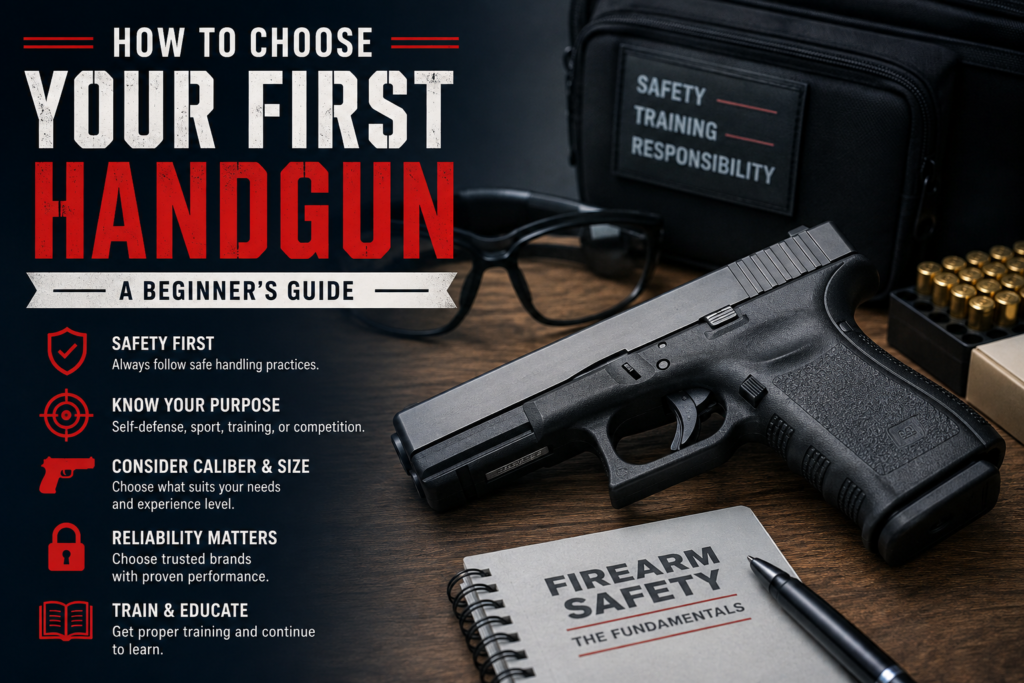
How to Choose Your First Handgun: A Beginner’s Guide to Safety and Responsible Ownership
Aug
Understanding Your First Handgun: A Beginner’s Safety and Education Guide
Introduction
For someone new to firearms, understanding handguns can initially seem complicated. Different manufacturers, models, calibres, sizes, terminology, and legal requirements can make the subject difficult to navigate.
Before considering any particular firearm, beginners should first understand the fundamentals of firearm safety, responsible ownership, secure storage, maintenance, and applicable laws.
This guide provides a general introduction for readers who want to learn about handguns responsibly. Regulations and ownership requirements differ considerably between European countries, so readers should always consult the relevant authorities and current legislation in their jurisdiction.
Start With Firearm Safety
Safety should be the first consideration for anyone learning about firearms.
A handgun should always be treated as a potentially dangerous object, regardless of its size, manufacturer, appearance, or familiarity.
Responsible firearm ownership includes developing consistent safety habits, preventing unauthorized access, using secure storage, and obtaining appropriate professional instruction.
Beginners should never assume that familiarity eliminates risk. Safe behaviour depends on maintaining the same level of caution every time a firearm is handled.
Understand Your Intended Context
Different people encounter handguns for different legitimate reasons.
These may include:
- Licensed sporting activities
- Target shooting
- Historical collecting
- Professional purposes
- Firearms education
- Lawful ownership where permitted
The legal requirements can differ significantly depending on the purpose and the country involved.
Before becoming involved with firearms, beginners should understand the rules that apply to their particular circumstances.
Learn Basic Handgun Terminology
Understanding terminology makes it easier to read firearm documentation and educational material.
Some common terms include:
Calibre
Calibre generally refers to a dimensional characteristic associated with a firearm and its ammunition. It may be expressed using metric or imperial terminology.
Calibre alone does not provide a complete description of a cartridge or determine whether different ammunition specifications are interchangeable.
Action
The term “action” generally describes the mechanism associated with the operation of a firearm.
Different handgun designs use different action systems, which is why beginners may encounter terminology such as single-action and double-action.
Magazine
A magazine is a component designed to hold ammunition for firearms that use detachable magazines.
Magazine design and capacity can vary depending on the firearm and the applicable law.
Frame
The frame is a major structural component of many handguns and provides a mounting structure for other components.
Barrel
The barrel is the component through which a projectile travels.
Barrel dimensions and specifications vary between firearm designs.
Understanding these basic terms can make firearm-related information much easier to follow.
Handgun Size and Design
Handguns are available in a wide range of designs and dimensions.
Depending on the model, differences can include:
- Overall dimensions
- Weight
- Grip configuration
- Barrel length
- Controls
- Materials
- Sight systems
- Magazine configuration
There is no universal design that is appropriate for every lawful owner or sporting participant.
Instead of focusing solely on appearance, beginners should learn how different design characteristics affect ergonomics, storage, maintenance, and applicable legal requirements.
Reliability and Manufacturer Reputation
Reliability is an important subject in firearm ownership.
When researching a manufacturer or model, consumers should look beyond advertising claims and examine reliable sources of information.
Useful sources can include:
- Manufacturer documentation
- Qualified instructors
- Reputable sporting organizations
- Established firearms publications
- Official safety information
- Applicable government resources
SafePoint Armory’s educational content should likewise provide useful information rather than relying on repetitive keyword placement or unsupported claims.
Professional Training Matters
Reading an online article is not a substitute for professional firearm instruction.
Anyone legally permitted to participate in shooting sports or firearm ownership should consider obtaining appropriate training from qualified instructors.
Professional instruction can help beginners understand:
- Fundamental safety principles
- Range rules
- Legal responsibilities
- Safe storage
- Responsible handling
- Emergency procedures
Training should be appropriate to the individual’s jurisdiction and lawful activity.
Safe Storage Is Essential
Secure storage is one of the most important responsibilities associated with firearm ownership.
Firearms should be stored in accordance with applicable laws and in a manner that prevents unauthorized access.
This is particularly important in households where children, visitors, or other unauthorized individuals may be present.
Storage requirements differ across Europe. A requirement applicable in Germany may not be identical to one applicable in France, Austria, Poland, the Czech Republic, or the United Kingdom.
For this reason, readers should always verify current local requirements.
Understanding European Firearm Regulations
European firearm regulations are not identical across all countries.
The European Union provides certain common legal frameworks, but individual member states maintain their own national rules concerning firearms.
Requirements can involve:
- Licensing
- Registration
- Ownership
- Storage
- Transportation
- Sporting use
- Transfers
- Importation and exportation
The United Kingdom has its own regulatory framework, while countries such as Germany, France, Austria, Poland, and the Czech Republic have their own national requirements.
Anyone researching firearm ownership in Europe should therefore look for information specific to their country rather than relying on a general “European firearm law.”
Country-Specific Research
For SafePoint Armory’s European audience, country-specific educational content can be particularly useful.
Future SafePoint Armory guides can cover topics such as:
Germany: General overview of firearm licensing and responsible storage.
France: General firearm categories and regulatory framework.
Austria: Overview of lawful ownership requirements.
Poland: General firearm licensing and sporting considerations.
Czech Republic: General overview of the country’s firearm regulatory framework.
United Kingdom: General information about the UK’s distinctive firearms legislation.
Each article should be reviewed against current official government information because firearm legislation can change.
Maintenance and Responsible Care
Responsible ownership also involves taking care of a firearm appropriately.
Owners should follow the manufacturer’s instructions and use qualified professional assistance when they are uncertain about maintenance requirements.
Manufacturer documentation is particularly important because firearm designs differ.
Avoid relying on generic online instructions when a manufacturer provides specific safety or maintenance information for a particular model.
Do Your Research Before Making Decisions
Beginners can easily become overwhelmed by the large number of firearm models and technical specifications available online.
A better approach is to learn the fundamentals first.
Research should include:
- Firearm safety
- Local laws
- Secure storage requirements
- Professional training
- Basic terminology
- Manufacturer documentation
- Sporting or lawful-use requirements
Once these fundamentals are understood, it becomes much easier to evaluate information responsibly.
Common Beginner Mistakes
Newcomers can sometimes focus too heavily on brand names, appearance, or individual specifications without understanding the broader responsibilities associated with firearm ownership.
Common mistakes include:
- Ignoring local regulations
- Treating online information as legal advice
- Failing to plan secure storage
- Relying on informal advice instead of qualified instruction
- Assuming laws are the same across European countries
- Choosing equipment based solely on popularity
- Neglecting manufacturer documentation
Responsible firearm education should always begin with safety and legality.
Frequently Asked Questions
What should a beginner learn first about handguns?
The first priority should be firearm safety, followed by basic terminology, local regulations, secure storage, and appropriate professional training.
Are firearm laws the same throughout Europe?
No. European countries have different national laws and requirements. Readers should consult the authorities responsible for firearms regulation in their own country.
Is calibre the only important specification?
No. Calibre is only one part of firearm and ammunition terminology. Other specifications and the complete model designation are also important.
Is online information enough to learn firearm safety?
No. Online educational material can provide background information, but it should not replace qualified professional instruction.
Where should firearm owners obtain legal information?
Current official government and law-enforcement resources should be treated as the primary source for applicable legal requirements.
Final Thoughts
Understanding your first handgun should begin with education, safety, responsibility, and legal awareness, not simply with comparing products.
For European readers, this is particularly important because firearm regulations differ between countries and can change over time.
Whether someone is interested in sporting activities, historical firearms, collecting, or another lawful purpose, responsible ownership requires appropriate knowledge and preparation.
SafePoint Armory can serve its European audience best by providing accurate, useful educational resources that help readers understand firearm terminology, safety principles, responsible ownership, and the regulatory environment in their country.
Always consult current official regulations and qualified professionals before making decisions concerning firearm ownership or use.
